Frequently Asked Questions
Disclaimer: The information and recommendations provided are believed to be accurate and reliable. It should not be assumed, however, that all responsive information has been provided or that additional information may not be relevant under certain circumstances or conditions. HVI assumes no responsibility or liability for the use or misuse of information, materials, processes, or techniques described, and it makes no warranty, guarantee, or representation whatsoever as to the absolute validity or sufficiency of any information provided. HVI does not approve or endorse any specific products.
-
What is HVI?
The Home Ventilating Institute (HVI) is a nonprofit association of the manufacturers of residential ventilating products.
-
What does HVI do?
HVI offers a variety of services including-but not limited to-test procedures, certification and verification programs for airflow and sound, energy performance for heat recovery ventilators, and market support. HVI conducts regular meetings to discuss common industry issues.
-
Does HVI recommend products?
No. Through a Certified Ratings Program, HVI provides a voluntary means for the residential ventilation manufacturers to report comparable and creditable product performance information based upon uniformly applied testing procedures performed by independent laboratories. Together these activities help to promote the health and growth of the home ventilation industry while providing consumers with valuable information and confidence in their choices.
-
What types of products are tested?
A wide range of home ventilating products are tested including bathroom exhaust fans, kitchen range hoods, downdraft kitchen exhausters, fresh air inlets, heat and energy recovery ventilators, inline fans, integrated supply and exhaust fans, powered attic ventilators, remote exterior mounted ventilators, static vents for attics and crawlspaces, and whole-house comfort ventilators.
-
Why did HVI create the certification and verification program?
The Certified Rating Programs of HVI were created to provide a fair and credible method of comparing ventilation performance of similar products. Not only are products HVI Certified, but a random verification program ensures that those products still meet their original performance ratings.
-
What does the certification program entail?
The certification process includes product identification, testing, verification, and certification.
-
Who created the test procedures?
The test procedures utilized for testing are, in most cases, developed by HVI using national and international consensus methods. In a few cases test standards previously developed by other agencies are recognized and adopted by HVI.
-
Who does the testing?
All testing for certification and verification is performed by laboratories independent of any HVI Member manufacturer.
-
What specifically is tested?
There are a variety of tests for air flow, noise level, and energy efficiency.
-
How do I know if a product is HVI certified?
A complete list of Certified Products, Manufacturers, and Brand Names can be found in the HVI Certified Home Ventilating Products Directory on this website.
-
Who recognizes HVI certification?
HVI Certification has been accepted and recognized as the method of performance assurance by many agencies some of which are: the U.S. Department of Housing and Urban Development, U.S. Department of Energy - Bonneville Power Administration, National Building Code of Canada, R2000 Housing Program - Canada, Washington State Building Code, Minnesota State Building Code, Building Officials and Code Administrators International (BOCA), International Conference of Building Officials (ICBO) and the National Electrical Manufacturers Association, Energy Star, and the American Society of Heating, Refrigerating, and Air-Conditioning Engineers (ASHRAE).
-
Why is ventilation important?
Every home needs ventilation to protect people from unhealthy indoor pollutants and to protect the building from excess moisture and heat. See the benefits of residential ventilation and view a list of common indoor pollutants.
-
How do I know if a product is HVI certified?
Members of HVI include manufacturers and distributors who have had their products tested and certified according to the HVI procedures. The HVI label on certified products is your assurance that the certified air flow and sound ratings for your ventilation equipment are the results of tests performed by an independent laboratory. For a list of companies that offer HVI Certified products, see the Manufacturers and Distributors section on this website.
-
What is a sone?
An internationally recognized measurement of sound output. Sones translate decibel ratings into numbers that correspond to the way people sense loudness. Ventilating fan sound levels are measured in sones.
-
What are the three ventilation strategies for home ventilation?
- Intermittent Local Ventilation: for bath, kitchen, and other moisture-, odor- and contaminant-producing areas.
- Continuous Whole House Ventilation: to remove stale, polluted air and distribute fresh, outdoor air throughout the house.
- Attic and Crawlspace Ventilation: to protect attics and crawlspaces.
-
What are HRVs?
Heat recovery ventilators (HRVs) bring in fresh air from the outdoors while exhausting stale air from the home, thus creating a balanced pressure system. For more details, see the HVI Home Ventilation & Indoor Air Quality Guide.
-
What are ERVs?
Energy recovery ventilators (ERVs) will modify the humidity content of the fresh air through the transfer of water vapor from one air stream to the other when bringing in fresh air from the outdoors and exhausting stale air from the home, thus creating a balanced pressure system. For more details, see the HVI Home Ventilation & Indoor Air Quality Guide.
-
What are static products?
The directory lists certified net free area in square inches for gable end, roof, sidewall, and under eave ventilators.
-
How do I determine the proper capacity of a fan?
Fans have differing capacities for moving air, measure in cubic feet per minute (CFM), thus making the location and use of the fan an important consideration. For more details, see the Determining Capacity section on page of the HVI Home Ventilation & Indoor Air Quality Guide.
-
Does HVI offer a publication with ventilating information?
Yes, the HVI Home Ventilation & Indoor Air Quality Guide offers essential specifications, explanations, and tips about home ventilation. Follow the link to see a copy of the guide.
-
Do you recommend specific products?
No. HVI is an association for residential ventilation manufacturers. HVI tests, certifies, and publishes residential ventilation product airflow, sound, or efficiency ratings. We cannot recommend one product over another or one HVI Member company over another.
-
Do you know where specific ventilation products or models can be purchased?
No. HVI is an association for residential ventilation manufacturers. HVI tests, certifies, and publishes residential ventilation product airflow, sound, or efficiency ratings. HVI does not manufacture or distribute products, however HVI Member companies contact information can be found in the HVI Certified Home Ventilating Products Directory on this website.
-
How do I know if a certain product is HVI certified?
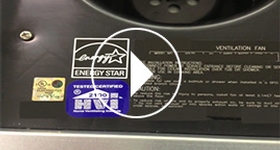
There is an HVI Tested/Certified sticker located on the product. For example: C-64322 would be the safety certification number; 50cfm refers to the airflow; .20WG is the static pressure at which the fan was tested; 4.0 sones is the sound level. You can also look for the specific model in the HVI Certified Home Ventilating Products Directory under the Manufacturer's name and listing on this website.
-
How can I determine the appropriate replacement for an older fan?
The model number, brand named, or manufacturer name coupled with the information on the HVI Tested/Certified sticker can be matched to current HVI Certified products. Sometimes this information has worn off or was not on the fan in the first place, especially if the fan is more than 10 years old; if so, the fan will then need to be replaced with a new model that is suitable. Consult the HVI Home Ventilation & Indoor Air Quality Guide for assistance in determining how much airflow (cfm) is appropriate for the room you wish to ventilate. There is also an HVI Certified Home Ventilating Products Directory that lists manufacturers of HVI Certified products with their specifications. Be sure to check you local building code requirements as well.
-
How do I calculate the proper airflow for a particular room that needs to be ventilated?
Consult the HVI Home Ventilation & Indoor Air Quality Guide for assistance in determining how much airflow (cfm) is appropriate for the room you wish to ventilate. There is also an HVI Certified Home Ventilating Products Directory that lists manufacturers of HVI Certified products with their specifications. Be sure to check your local building code requirements as well.
-
Do you provide instructions on how to install fans or other ventilation products?
HVI does not have any information on installing specific products. Contact the manufacturer of the fan for installation instructions. HVI recommends that bath fans and range hoods be ducted to the outside.
-
What are the test laboratory accreditation requirements for lab testing products that receive HVI certification?
- Original lab recommendation from HVI General Membership, HVI Engineering Committee, and the HVI Board.
- Volunteer member engineers visit labs and work with technicians on proper equipment and test set-up.
- Members send in various products for round-robin testing; results are compared to other accredited labs.
- Test results are presented to HVI Members, HVI Engineering Committee, and the HVI Board in a meeting; a motion is made to accredit the lab, whereby the lab will be approved if there is a unanimous vote.
- What accredited labs does HVI currently use?
Bath Fan, Rangehoods, Other Room Exhaust Fans, Inline Fans, Whole House Comfort Ventilators, etc. use two HVI Procedures: HVI 915 - Procedure for Loudness Rating of Residential Fan Products; HVI 916 - Air Flow Test Procedure. Testing is quoted and performed through the following third-party labs:
- Energy Systems Laboratory
Texas A&M
College Station, Texas USA
- AMCA Laboratory
Air Movement & Control Assoc. Int'l, Inc.
Arlington Heights, IL USA
HRV's, ERV's, and Integrated Supply and Exhaust Ventilator Testing is quoted and performed through the following third-party lab:
-
Bodycote Materials Testing Canada Inc.
2395 Speakman Drive
Mississauga, ON Canada L5K 1B
- Is there a test that can be conducted inside a house by which proper ventilation can be determined?
We do not know of any type of test to determine proper airflow in a house. Consult the HVI Home Ventilation & Indoor Air Quality Guide for assistance in determining how much airflow (cfm) is appropriate for the room you wish to ventilate. Also, there is an HVI Certified Home Ventilating Products Directory that lists manufacturers of HVI Certified products with their specifications. Be sure to check your local building code requirements as well. With proper ventilation, you should be able to prevent mold and moisture damage.
-
How does having an HVI Certified product make a difference?
HVI Certified products have the actual airflow (cfm) labeled on the fan, not an exaggerated claim, because it has been independently tested according to industry-approved procedures.
- When having a new house built, what is important for the contractor to know?
We recommend that the contractor follow manufacturer's installation instructions. Also, duct material, size, length, and number of bends can adversely affect the airflow (cfm) of the ventilation product.
|